
Connecting Information, Workflows, Technologies, and People
Animal research facilities have different digitalisation needs and starting points.
A facility with an established animal-management system may want to extend digital support to the cage side. Another may need to bring animal care, facility operations, and study execution into a more connected environment.
The opportunity is to connect existing and new technologies within a coordinated digital environment.
A connected digital ecosystem provides a common information structure while allowing different systems, devices, and interfaces to support the work they are designed for.
The objective is to create a digital environment where information, workflows, technologies, and people work together to support daily operations, research activities, and future development.
One Data Foundation, Different Ways of Working
Animal care, veterinary activities, facility management, and research involve different responsibilities, yet often depend on the same underlying information.
An animal may be associated with a cage, room, study, treatment, procedure, measurement, clinical event, or sample.
A shared data foundation maintains these relationships, allowing information to be used across different workflows while preserving its context.
A measurement, for example, becomes more meaningful when it remains linked to the relevant animal, study, procedure, and time point. This supports reliable interpretation, study review, and potential future reuse of research data.
This continuity also supports animal welfare activities. Clinical observations, health assessments, and treatment records can remain associated with the relevant animals and be available to authorised care, veterinary, and research teams.
Different roles require different views of this information. A technician may need cage-side instructions, a veterinarian clinical history, a researcher study progress, and a facility manager operational oversight.
The interface changes with the task, while the underlying information remains connected.
Connect the Entire Workflow
A connected ecosystem maintains the relationships between information and activities throughout the research process, including across different systems.
Consider an in vivo study.
A protocol defines the planned activities. Animals are assigned, procedures and measurements are scheduled, and tasks are performed in the facility.
Observations, treatments, measurements, and other events recorded during execution become part of the study record, supporting monitoring, review, and reporting.
Many of these activities take place at the cage side. Connecting this point of work to the wider digital environment helps keep information associated with the relevant animals, studies, and tasks.
The same principle applies to facility operations, where animal care, veterinary activities, housing, and daily tasks are closely related.
Bringing these activities together provides continuity across teams while preserving the specialised workflows each requires.
Build on What Already Works
A well-designed digital ecosystem should accommodate facilities at different stages of digitalisation.
Existing animal-management systems, laboratory applications, instruments, and institutional platforms may already support important activities.
When planning further digital development, facilities can consider:
- Where is information generated, and who needs to access it?
- Which existing systems should remain in place?
- Where would better connectivity or additional functionality provide the greatest value?
- How can new capabilities support future requirements?
These questions help establish practical priorities for digital development.
A flexible architecture combines a consistent internal data structure with integration capabilities for external technologies. Modular functionality allows facilities to expand according to operational needs, while configurable workflows, permissions, and terminology support different organisational requirements.
Together, these elements create an environment where systems exchange relevant information, teams coordinate activities, and new functionality can be introduced as needs evolve.
This approach can help facilities protect existing investments, respond to changing research needs, and strengthen their long-term operational capabilities.
How PicoTeam InVivo Brings These Principles Together
This approach is central to PicoTeam InVivo — Research and Facility Operations Platform.
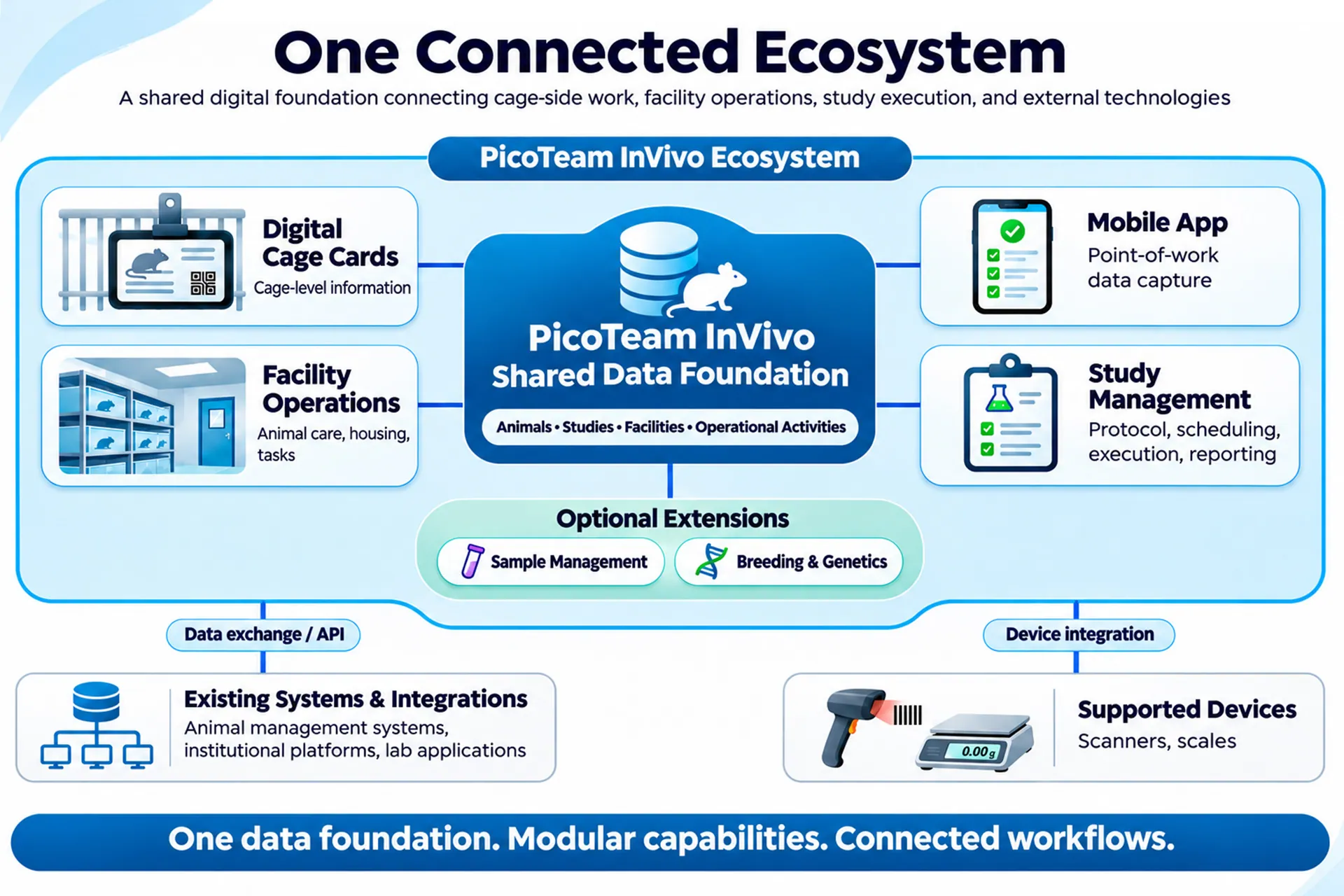
Built around a shared data model connecting animals, studies, facilities, and operational activities, PicoTeam InVivo brings different capabilities together within one digital foundation.
Digital Cage Cards provide relevant animal and cage information where care takes place, including clinical indicators and study-related information. The Mobile App supports activity documentation and data capture at the point of work, including offline workflows.
Facility Operations extends the platform into animal lifecycle management, housing, husbandry, veterinary activities, welfare assessments, and coordinated daily tasks.
Study Management connects protocol definition and animal assignment with scheduling, execution, and reporting. Protocol-driven tasks, version history, and approval workflows provide additional structure for managing study activities.
Information recorded during execution can remain linked to the relevant animals, studies, tasks, locations, and users, supporting continuity and contextual traceability.
One Platform, Different Starting Points
PicoTeam InVivo offers three progressively expanding packages: Digital Cage Cards, Facility Operations, and Study Management.
A facility with an established animal-management system may begin with Digital Cage Cards and mobile workflows, integrating relevant cage and animal information with its existing system.
As requirements develop, it may introduce broader Facility Operations functionality or extend into Study Management to connect research planning and execution.
The ecosystem also supports integration with external systems through data exchange and API capabilities. Supported devices, including scanners and scales, can connect physical activities with digital records.
Specialised modules, such as Sample Management and Breeding & Genetics, provide further opportunities to expand.
The appropriate implementation depends on the facility’s existing systems and operational requirements.
One Connected Ecosystem
The value of a connected digital ecosystem lies in how effectively it brings information, technologies, workflows, and people together.
It allows facilities to build on existing technologies, introduce new capabilities gradually, and adapt as research and operational needs evolve.
One data foundation. Modular capabilities. Connected workflows. The right interface for each task.
This is the approach behind PicoTeam InVivo — connecting cage-side information, facility operations, and study execution within a shared digital foundation, with the flexibility to integrate existing technologies and expand over time.