
Case Study: Connecting animal records, communication, and daily operations.
Animal research facilities coordinate treatments, clinical observations, welfare assessments, and study activities across multiple teams. Yet the data supporting these activities is often distributed across paper records, spreadsheets, emails, and disconnected systems, making it difficult to access current information where work is performed.
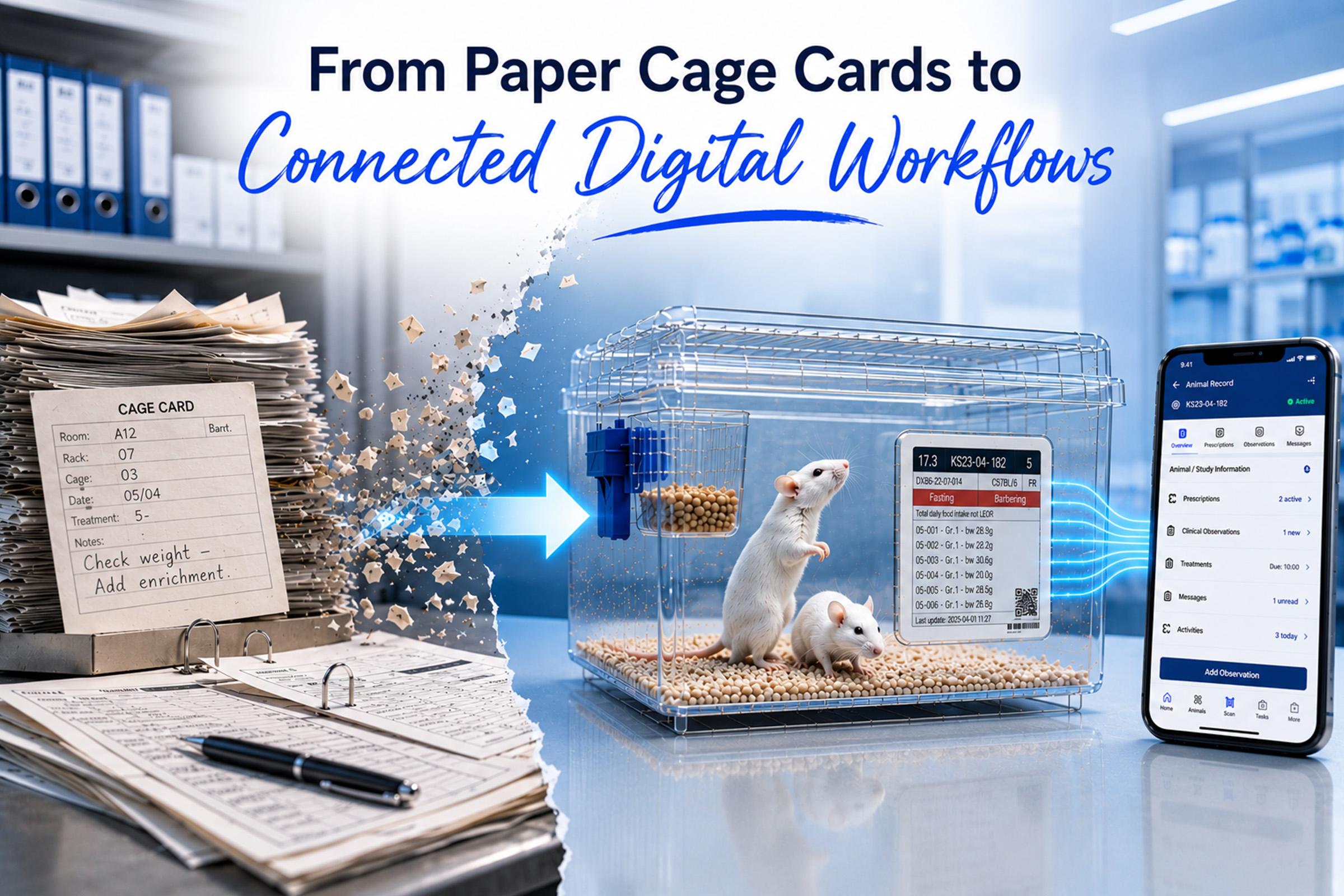
This case study shows how one facility modernized its cage-side operations by implementing PicoTeam Digital Cage Cards together with the PicoTeam Mobile App, creating connected digital workflows at the point of care.
The Starting Point
The facility relied on traditional paper cage cards as the primary source of cage-level information. Whenever information changed, cards had to be manually replaced or updated. Treatment adjustments, clinical observations, animal transfers, and special handling instructions often depended on handwritten notes, verbal communication, or later registration in separate systems.
The objective was not simply to replace paper cage cards. It was to improve access to operational data, reduce manual administration, and strengthen cage-side workflows without disrupting established routines.
A Connected Way of Working
The facility introduced PicoTeam Digital Cage Cards together with the PicoTeam Mobile App.
The Digital Cage Card provided an always-visible overview at the cage, while the PicoTeam Mobile App gave staff immediate access to the complete animal record and the tools needed to document daily activities.
Using the Mobile App, staff scanned the QR code or used the built-in RFID to open the relevant animal record, where they could review animal data, register observations, confirm prescriptions, add messages, and record completed activities.
Accessing records, performing tasks, and documenting activities became part of one connected cage-side workflow. Instead of updating paper and documenting work later, staff accessed, updated, and shared records as part of their normal daily work.
Information at the Point of Care
During daily rounds, staff could immediately identify animals requiring attention. The Digital Cage Card displayed current cage information and key status indicators, while the PicoTeam Mobile App provided access to the complete animal record, prescriptions, clinical observations, and documentation tools.
Observations and completed activities were recorded in the Mobile App and became immediately available to other staff. Documentation became part of the daily workflow instead of a separate administrative task, improving both accuracy and consistency.
More Connected Communication
Communication became more structured across the facility.
Instead of relying on handwritten notes or verbal handovers, treatment updates, transfer information, handling instructions, and clinical observations were attached directly to the animal record through the Mobile App.
Once saved, updates became available through both the Digital Cage Card and the Mobile App, ensuring everyone involved in animal care and study execution worked from the same current information.
Clinical Visibility
Clinical observations became easier to capture and follow.
When staff identified a welfare concern, they documented it in the Mobile App. Each observation was automatically linked to the correct animal together with the user who recorded it and the exact date and time, supporting accurate follow-up and traceability.
Prescriptions were also available at the cage side, allowing staff to review treatment details and confirm completed actions digitally.
Less Administration, Greater Operational Visibility
Replacing paper cage cards reduced repetitive administrative work. Information was entered once and shared across the workflow, eliminating repeated printing, updates, and manual reconciliation.
This improved consistency, reduced administrative effort, and gave supervisors better visibility into daily operations, making it easier to coordinate work across the facility.
Results
The implementation resulted in:
- Faster access to animal and cage records
- Improved accuracy and consistency of animal records
- A shared source of current animal information across the facility
- More consistent communication
- Better clinical follow-up
- Reduced administrative workload
- Improved workflow consistency
- Better operational visibility
- Stronger traceability
- Better support for animal welfare
Conclusion
Implementing PicoTeam Digital Cage Cards together with the PicoTeam Mobile App streamlined cage-side workflows by reducing manual administration and improving operational efficiency.
More importantly, the implementation established a connected digital foundation. Digital Cage Cards became the entry point into One Connected Ecosystem, bringing animal records, communication, and daily workflows together within a shared digital platform.
These connected workflows are part of PicoTeam InVivo—PicoTeam’s modular digital platform for animal research facilities. Designed to adapt to different operational requirements, PicoTeam InVivo allows facilities to choose and combine the modules that best support their workflows. Facilities can start with the functionality they need today and expand the platform as new operational requirements emerge—all while keeping workflows connected within the same ecosystem